7/11/2016
Quando l’onestà diventa valore aggiunto
Il concetto filosofico del Karma dice che se fai del bene agli altri, riceverai del bene. Questo sembra essere il principio guida di TIV, un’azienda di Dosson di Casier, Treviso. Per Maurizio Bergamo e Davide Cappellazzo, l’etica aziendale va di pari passo con la ricerca della qualità. I due principi si sostengono e alimentano a vicenda, con lo scopo di instaurare con i clienti un rapporto di fiducia e collaborazione. All’atto pratico, qualità e correttezza si traducono in formazione, controllo della qualità, precisione, e costante aggiornamento tecnico. Ma soprattutto vogliono dire onestà e affidabilità che, sebbene siano ormai merce rara, rappresentano l’unica strada per acquisire e mantenere clienti fedeli e soddisfatti. Scopriamo di più con questa nuova intervista.
Gasparini: Buongiorno a Davide Cappellazzo e Maurizio Bergamo, è un piacere incontrarvi. Cominciamo con una semplice domanda: come è nata TIV?
Davide: È nata con il sig. Giovanni, il papà del mio socio. Io ho iniziato a lavorare qui durante le estati delle superiori. Quando ho cominciato a lavorare in TIV c’erano solo 2 capannoni e la sede non era qui a Dosson; ci siamo trasferiti qui nel 2003.
GI: Oltre a lavorare per conto terzi, producete anche una macchina per la movimentazione degli stampi. Com’è nata questa idea?
DC: È una macchina che è venuta fuori così, per caso, collaborando con un’azienda che produce stampi. È una macchina difficile da sviluppare perché non fa produzione. Ora ne stiamo facendo due per una multinazionale che ha iniziato ad acquistarle e le sta distribuendo in gran parte del mondo: una di queste andrà negli USA e l’altra in Messico.
GI: Abbiamo notato che nel vostro sito si legge “TIV si è sviluppata negli anni facendo della qualità assoluta, della sicurezza e della semplicità d’uso dei propri prodotti il mantra aziendale. Con i nostri prodotti, diamo sicurezza ai vostri movimenti”. Ma cosa vuol dire per voi “qualità”? Come la misurate e come la mantenete?
DC: Per noi qualità è “meno errori fai e meno problematiche dai al cliente”. Se inizi a fare dei lavori e ti torna indietro il materiale, vuol dire che la qualità non va bene. Ci sono aziende che non sentiamo quasi mai, quindi vuol dire che il prodotto va bene.
GI: Parlami di come lavorate, delle vostre lavorazioni per conto terzi. Su cosa siete forti? Perché io dovrei venire da voi e non scegliere un’altra azienda? Cosa mi offrite di più?
DC: Sicuramente per la qualità dei nostri prodotti, per la finitura e per, come dicevamo prima, anche per i pochi errori; quello ti porta alla flessibilità e alla velocità di fare anche eventuali urgenze. Queste sono le nostre principali caratteristiche che ci hanno portato a crescere negli ultimi anni. Noi non facciamo niente di serie; facciamo 20-30 pezzi al massimo, e molte volte facciamo anche prototipi.
GI: La vostra prima Gasparini?
DC: La nostra prima Gasparini è degli anni ’80, una PO40. La usiamo per fare il piega-schiaccia sull’alluminio. Sul 3-4 mm non esistono piega-schiaccia, quindi ci siamo “inventati” un metodo. Finché funziona quella, bene; poi… (ride). No, quella macchina penso che non si romperà mai.
GI: Recentemente avete acquistato una X-Press 330 tonnellate per 4 metri con luce e corsa maggiorate ed accompagnatori.
DC: Eh si, quella ci è stata costruita praticamente su misura.
GI: Come tutte le nostre macchine del resto. Come mai l’avete scelta? Non volevate provare un’altra marca dopo la PO40?
DC: No, prima di questa ne abbiamo avuto un’altra, di un’altra marca. Prima di acquistare la 330/4m penso di aver contattato 7/8 aziende, ma in Gasparini ho visto qualcosa in più delle altre. In primis la persona che ci ha seguito commercialmente. In secondo luogo per quello che facciamo noi, la macchina deve essere duttile, facile e veloce da utilizzare, oltre che essere robusta e con due spalle solide. L’ho vista più completa in quel senso. E poi anche a parità delle altre marche, Gasparini aveva qualcosa in più anche sulla tecnologia.
GI: Quindi avevate bisogno di una macchina su misura; che cosa vi ha permesso di realizzare la 330/4 metri?
DC: Più che altro, rispetto alla pressa che avevamo prima, dovevamo avere più tonnellaggio. E poi ne avevamo bisogno per certi lavori per i quali sia la corsa, sia la luce dovevano essere maggiori. Ad esempio, facendo anche diverse scatole, avevamo bisogno della comodità di estrarre i pezzi con più facilità perché altrimenti ci toccava fare due pezzi ed assemblarli dopo. Erano lavori che già facevamo, ma con difficoltà. Quindi tutto sommato siamo contenti della macchina.
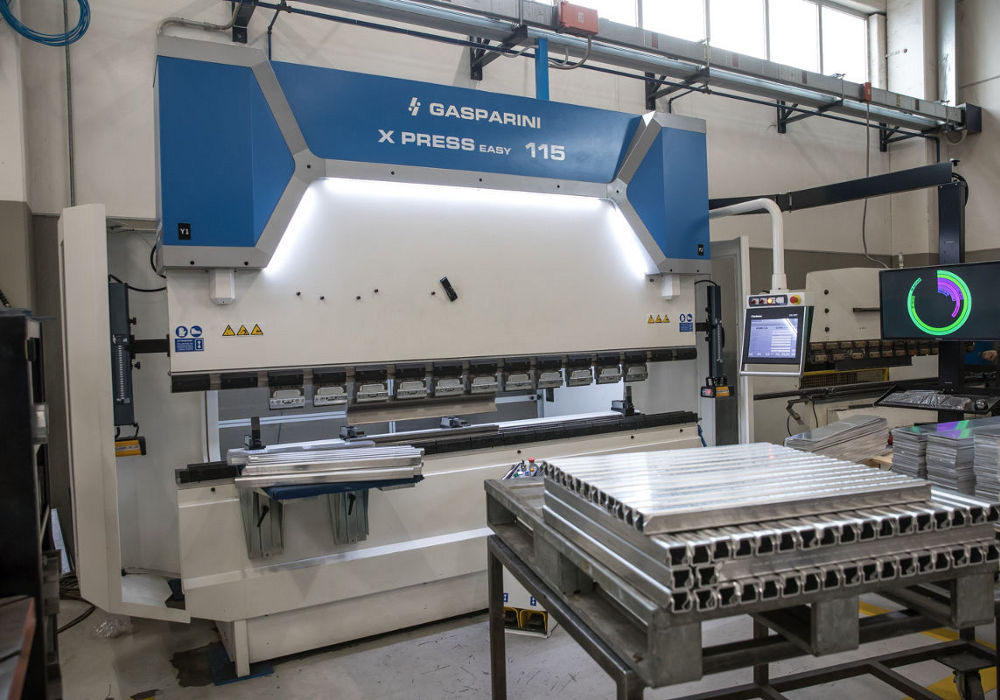
GI: Ed infatti poi ne avete presa un’altra, da poco anche. Una Easy 115 tonnellate di 3 metri. Questa per cosa la usate?
DC: Questa l’abbiamo presa in sostituzione di un’altra che usavamo, che però ormai aveva quasi 18 anni e non aveva la centinatura sotto, quindi con lunghezze oltre il metro dovevi arrangiarti con le cartine e tutto quello che ci va dietro. Alla fine è uguale alla 4 metri, però questa ha in più il bloccaggio pneumatico, la bombatura ed il controllo numerico.
GI: E come mai avete scelto Gasparini per la terza macchina?
DC: Perché ci siamo trovati bene con le prime due, perché siete vicini, e soprattutto perché avendo installato un bel dialogo con un’azienda, poi si riesce a collaborare assieme.
GI: Facciamo qualche domanda anche a Maurizio Bergamo, titolare dell’azienda. Tra TIV e Gasparini c’è sempre stato un rapporto di collaborazione, nel senso che vi abbiamo fatto provare in anteprima alcuni nuovi prodotti ed in alcune occasioni vi abbiamo anche contattato per avere un feedback da voi, avere una vostra opinione sui nuovi prodotti. Quanto importante è, secondo te, collaborare tra aziende? Ci sono altri produttori/fornitori/clienti che vi fanno provare i loro prodotti oppure voi fate provare i vostri in anteprima, vi aiutate a svilupparli? È una strada che, secondo te, ha senso percorrere oppure no?
Maurizio: Che sia utile, quello sicuramente. Questa cosa della collaborazione tra le aziende l’avevo proposta anche io ad alcune della zona, nel 2001. Volevo che facessimo gruppo, magari riuscivamo a mettere assieme verniciatura, tornitura, fresatura, piegatura e assemblaggio così da diventare una potenza e prendere anche commesse importanti. La risposta più bella è stata “no”. E ora la maggior parte delle aziende a cui avevo chiesto questa cosa o non ci sono più o sono in difficoltà. Come dico sempre, “da soli si fa per uno, in due si fa per tre”. Noi qui nella zona non abbiamo una mentalità industriale, abbiamo una mentalità personale: nel senso, il mio è mio, punto. Secondo me questo nasce dal fatto che effettivamente, qua in zona, abbiamo pochi veri imprenditori che si possano chiamare tali. La maggior parte delle altre aziende che sono nate venivano fuori dal lavoratore che si è messo in proprio. Qua in zona abbiamo piccole realtà che purtroppo non si svilupperanno mai. E fanno la “guerra del prezzo” che è comunque una guerra sbagliata perché se calo io, cali anche tu, se cali tu, calo anche io… Ed ad un certo punto l’azienda non può più rimanere in piedi perché non ha più soldi per investire in nuove tecnologie. E voi lo sapete meglio di me che senza nuove tecnologie non si va avanti.
GI: Infatti una delle cose che sicuramente vi fa distinguere dagli altri è il fatto che avete investito molto, comprato macchinari nuovi, insomma cercate di rimanere sempre al passo. Alla fine è l’unico modo per non rimanere indietro.
MB: Sono d’accordo: mi è capitato diverse volte di visitare certe realtà che dovrebbero essere la mia concorrenza, ma che alla fine non ritengo tali. E quando vai in queste realtà, vedi che le macchine più nuove hanno 20 anni. Non si può competere con quelle. Io lavoro per conto mio da quando avevo 30 anni, quest’azienda era di mio padre e poi l’ho acquistata. Nella vita ho avuto due maestri, che mi hanno insegnato tutto quello che so oggi. Anzi tre, perché mio padre ne sapeva, era molto bravo. Ma nella mia vita lavorativa ho trovato due grandi persone che mi hanno insegnato molto; sono stato fortunato ad averli incontrati. Prima ho incontrato un imprenditore della zona, che è diventato ormai un colosso. Lui mi diceva sempre “lavora bene e vedrai che crescerai meglio”. Era molto pignolo, me lo avrà ripetuto come minimo 100 volte, finché l’ho capito. Ogni tanto veniva a vedere i miei lavori e mi criticava. E io ogni volta pensavo “Beh, se mi dice così vuol dire che c’è anche altra gente che vuole il prodotto così come lo vuole lui”. Dall’altra parte invece ho conosciuto una persona che mi ha insegnato tanta tecnica. Era un tecnico di prima categoria: sapeva tutto sui materiali. La somma di queste due persone mi ha dato una buona esperienza. Però bisogna avere il coraggio di ascoltare i maestri, che non è cosa da tutti.
GI: E in questi anni di crisi, per voi come è stata la “burrasca”? Come ne siete usciti?
DC: Il 2009 è stato l’anno peggiore. Nel 2008 andavamo molto bene, ma l’anno dopo abbiamo fatto metà fatturato. La nostra fortuna è stata che, nel 2009, abbiamo acquistato un laser. Penso che senza quella macchina là a quest’ora avremmo già chiuso, perché comunque ci ha portato ad una miglioria: lavoravamo meglio, lavoravamo anche altri metalli ed i tempi erano diminuiti. Da là abbiamo cominciato ad acquisire nuovi clienti. Più che altro sono stati loro a trovare noi, soprattutto con il passaparola, il sentito dire.
GI: Quindi per uscire dalla crisi la vostra ricetta sono stati gli investimenti nei macchinari. Parlando di dipendenti, quanti siete in azienda? E che ruoli hanno?
DC: Siamo in 12. Abbiamo 2 segretarie, 1 progettista per il laser, 4 nel reparto taglio e piegatura, e 5 persone tra saldatori e carpentieri.
GI: Cos’hanno di speciale queste persone? Cos’è che ti fa dire “posso prendere questa commessa perché conosco i miei uomini e con loro posso andare anche ad occhi chiusi”?
DC: Molti di loro lavorano qua da anni, perciò sai già in cosa uno è specializzato piuttosto che l’altro. Poi ognuno ha le sue caratteristiche. Devi anche sapergli dare un lavoro che gli piace. Poi c’è ovviamente chi è più bravo a fare una cosa piuttosto che un’altra. Però io dico sempre che se non hai anche quello che ti scarica la lamiera dal laser, non vai avanti. Se non c’è la ragazza che ti inserisce gli ordini, se io non faccio preventivi, non arrivano ordini e non si va avanti. Tutti sono importanti.
GI: Si vede proprio che siete molto in sintonia, andate molto d’accordo, quasi come foste una famiglia.
MB: Famiglia quasi, perché bisogna mettere dei paletti anche là, ogni tanto. Comunque ci devono essere dei parametri: tu lavori, io faccio di tutto per farti lavorare. Io le dico ogni tanto queste cose ai miei uomini, soprattutto durante le riunioni. Gli dico, “ragazzi, io cerco di trovare lavoro al più buon prezzo possibile. E più porto a casa, più posso dare anche a voi” (ride). Cerchiamo sempre di migliorare il più possibile e facciamo sempre investimenti, anche sulla salute dei lavoratori. Adesso ci stiamo facendo fare uno studio sull’illuminazione, per cambiare tutte le lampade e mettere quelle a LED. Il neon ha uno sfarfallio a 50 Hz che anche se non lo vedi stanca molto l’occhio, e inoltre c’è anche l’aspetto ecologico. Certo, potrei continuare con le lampade al neon, che mi costerebbero meno. Ma se devo cambiare, le cambio con una tecnologia nuova. Altrimenti si rimane indietro: è inutile che vada a comprare una cosa già obsoleta, pur sapendo che c’è la possibilità di acquistare il nuovo. È lo stesso discorso che facevamo quando abbiamo deciso di acquistare una nuova piegatrice. Avevamo diverse aziende che ci stavano dietro e io e Davide eravamo vicinissimi nell’acquistare una pressa di un’altra marca, che costava anche meno della vostra. Però era come prendere una macchina identica a quella vecchia che dovevamo sostituire e metterne su un’altra uguale: quindi se ci andava bene ci durava 10 anni. Anche per quello abbiamo puntato su Gasparini, perché comunque su tecnologie innovative è sempre stata un po’ più avanti. All’inizio non è che mi fidassi tanto, sinceramente. Però ho detto “va bene, proviamo”. Ed effettivamente siamo stati molto contenti della prima macchina, per quello abbiamo acquistato anche la seconda.
GI: Ora vi faccio una domanda abbastanza strategica per l’azienda: cosa volete fare nel futuro? Che obiettivi avete? Come e cosa volete diventare? Quali sono i programmi?
MB: Ormai l’azienda si è sviluppata molto bene. Uno dei prossimi progetti sarà quello di cambiare sicuramente il laser ed ampliarci, ormai non ci stiamo più qua. Negli ultimi 3 anni siamo cresciuti tanto di clientela, di lavoro, di tutto. L’anno scorso abbiamo fatto un lavoro per un cliente ed era già il terzo anno che glielo facevamo, un lavoro lungo 6 mesi che impegnava 2 persone. Un bel lavoretto. L’anno in cui non abbiamo fatto quel lavoro, abbiamo comunque fatto più fatturato e consumato più lamiera. Per quel lavoro ci volevano 700 quintali di lamiera. Sì, forse abbiamo perso un cliente, ma in compenso ne abbiamo presi altri. Ormai noi lavoriamo solamente con le nicchie di mercato. Magari il prezzo sarà anche più alto rispetto agli altri concorrenti, ma facciamo prodotti di alto livello. In certe occasioni abbiamo anche dei clienti che se devono fare un lavoro standard ci chiedono il preventivo. Se invece devono fare un lavoro ad hoc, che non deve avere difetti, non ci chiedono neanche il preventivo. Ci dicono “fallo, e poi dicci quanto costa”. Si instaura anche un rapporto di fiducia con i clienti, certi sono con noi da 20 anni. Anche quando facciamo un lavoro per un cliente ad economia e poi gli diciamo il prezzo finale, non abbiamo mai avuto contestazioni. Questo vuol dire che tutto sommato il prodotto è buono. Quello che è giusto è giusto, bisogna essere onesti. Anche perché altrimenti si innesca tutto un meccanismo che è meglio evitare. Vedo che quelli che non lavorano con correttezza, non stanno lavorando, ovviamente. E costano magari il 40% in meno di noi. È vero, noi facciamo anche il 40% in più rispetto a loro, ci mettiamo più tempo a fare un pezzo. Ma noi partiamo con il piede giusto già dall’inizio. Questo paradossalmente semplifica molto il lato produttivo: tutti i processi devono essere di qualità. Se non hai la qualità, non fai niente.
GI: E secondo te invece, noi di Gasparini, in cosa dovremmo migliorare? Intendo a 360°, sia dei prodotti, sia nel modo di vendere.
DC: Questa domanda è ancora più difficile dell’altra (ride). Bene o male, sia come vendita, sia come prodotto ci siamo trovati bene. Poi andare più nello specifico e dirvi “il portoncino invece di qua, mettetemelo di là” insomma, quello dipende dai gusti e mi sembra banale. Però in generale, sia come assistenza che come prodotto, non ho avuto niente da ridire.
GI: Grazie mille ad entrambi, a presto!
7/11/2016
When honesty becomes added value
The philosophical concept of Karma says that if you do good to others, you will receive good . This seems to be the guiding principle of TIV, a company from Dosson di Casier, Treviso. For Maurizio Bergamo and Davide Cappellazzo , company ethics go hand in hand with quality research. The two principles support and nourish each other, with the aim of establishing a relationship of trust and collaboration with customers. In practice, quality and correctness translate into training, quality control, precision, and constant technical updating. But above all they want to say honesty and reliability which, although they are now rare goods, represent the only way to acquire and maintain loyal and satisfied customers. Let’s find out more with this new interview. Gasparini: Good morning to Davide Cappellazzo and Maurizio Bergamo, it is a pleasure to meet you. Let’s start with a simple question: how was TIV born?
Davide: She was born with Mr. Giovanni, the father of my partner. I started working here during the summers of high school. When I started working at TIV, there were only 2 warehouses and the headquarters were not here in Dosson; we moved here in 2003.
GI: In addition to working for third parties, you also produce a mold handling machine. How was this idea born?
DC: It’s a machine that came out like that, by chance, working with a company that makes molds. It is a difficult machine to develop because it does not produce. Now we are doing two for a multinational company that has started to buy them and is distributing them in most of the world: one of these will go to the USA and the other to Mexico.
GI: We have noticed that in your site we read “TIV has developed over the years making the quality, safety and ease of use of its products the company mantra. With our products, we give security to your movements “. But what does “quality” mean for you? How do you measure it and how do you keep it?
DC: For us quality is “fewer mistakes you make and less problematic from the customer”. If you start doing the work and you get the material back, it means that the quality is not good. There are companies that we hardly ever hear, so it means that the product is fine.
GI: Tell me about how you work, your work for third parties. What are you strong about? Why should I come to you and not choose another company? What do you offer me more?
DC: Certainly for the quality of our products, for the finish and for, as we said before, even for the few errors; that brings you to the flexibility and speed of doing even any urgencies. These are our main characteristics that have led us to grow in recent years. We do not do anything standard; we make 20-30 pieces at most, and many times we also make prototypes.
GI: Your first Gasparini?
DC: Our first Gasparini is from the 80s, a PO40. We use it to make the fold-crush on aluminum. On 3-4 mm there is no fold-crush, so we “invented” a method. As long as that works, well; then … (laughs). No, that car I think it will never break.
GI: Recently you bought an X-Press 330 tons per 4 meters with increased light and stroke and escorts.
DC: Oh yes, that was built to us practically made to measure.
GI: Like all our other machines. Why did you choose it? Did not you want to try another brand after the PO40?
DC: No, before this we had another, of another brand. Before buying the 330 / 4m I think I have contacted 7/8 companies, but in Gasparini I saw something more than the others. First of all the person who has followed us commercially. Secondly, for what we do, the machine must be ductile, easy and quick to use, as well as being robust and with two solid shoulders . I saw her more complete in that sense. And then even with the same number of other brands, Gasparini had something more on the technology too.
GI: So you needed a custom machine; what has allowed you to build the 330/4 meters?
DC: More than anything, compared to the press we had before, we had to have more tonnage. And then we needed it for certain jobs for which both the race and the light had to be greater. For example, if we also made several boxes, we needed the convenience of extracting the pieces more easily because otherwise we had to make two pieces and assemble them later. These were jobs we already did, but with difficulty. So all in all we are happy with the car.
GI: And in fact then you have taken another, recently. An Easy 115 tons of 3 meters. What do you use it for?
DC: This we have taken to replace another that we used, but now was almost 18 years and did not have the bow below, then with lengths over a meter you had to arrange with the maps and everything what goes behind it. At the end it is equal to 4 meters, but this has moreover the pneumatic locking, the camber and the numerical control.
GI: And why did you choose Gasparini for the third machine?
DC: Because we were comfortable with the first two, because you are close, and above all because having installed a nice dialogue with a company, then you can work together.
GI: We also ask some questions to Maurizio Bergamo , the company’s owner. Between TIV and Gasparini there has always been a relationship of collaboration, in the sense that we have made you try out some new products and on some occasions we have also contacted you to get feedback from you, have your opinion on new products. How important is it, in your opinion, to collaborate between companies? Are there any other manufacturers / suppliers / customers who let you try out their products or do you have your preview tested, do you help to develop them? Is this a road that, in your opinion, makes sense to travel or not?
Maurizio: That is useful, that surely. This thing of the collaboration between companies I had also proposed to some of the area, in 2001. I wanted to make a group, maybe we could put together painting, turning, milling, bending and assembling so as to become a power and also take important orders. The best answer was “no”. And now most of the companies I’ve been asking for this thing either are gone or are in trouble. As I always say, “ alone is done for one, two is done for three “. We here in the area do not have an industrial mentality, we have a personal mentality: in the sense, mine is mine, period. In my opinion this stems from the fact that actually, here in the area, we have few real entrepreneurs that can be called such. Most of the other companies that were born came out of the self-employed worker. Here in the area we have small realities that unfortunately will never develop. And they make the “ price war ” which is still a wrong war because if I fall, you too, if you fall, I too … And at some point the company can no longer remain standing because it has no more money to invest in new technologies. And you know better than me that without new technology is not going on .
GI: In fact one of the things that surely makes you different from the others is the fact that you have invested a lot , bought new machinery, in short, try to stay always up to date. In the end it is the only way not to fall behind.
MB: I agree: several times I have visited certain realities that should be my competition, but that I do not consider in the end. And when you go into these realities, you see that the newer cars are 20 years old. You can not compete with those. I’ve been working on my own since I was 30, this company belonged to my father and I bought it. In life I had two masters, who taught me everything I know today. Indeed three, because my father knew, was very good. But in my working life I found two great people who taught me a lot; I was lucky to have met them. Before I met an entrepreneur in the area, who has now become a colossus. He always told me “ works well and you’ll see that you’ll grow better “. He was very picky, he would have repeated it at least 100 times, until I understood it. From time to time he came to see my work and criticized me. And every time I thought, “Well, if you say so, it means that there are other people who want the product as he wants it”. On the other hand, I met a person who taught me so much technique. He was a first-class technician: he knew everything about materials. The sum of these two people gave me a good experience. But we must have the courage to listen to the teachers , which is not something for everyone.
GI: And in these years of crisis, for you how was the “storm”? How did you get out?
DC: 2009 was the worst year. In 2008 we went very well, but the following year we made half of the turnover. Our luck was that, in 2009, we bought a laser. I think that without that car, we would have already closed it at this time, because it still led us to an improvement: we worked better, we also worked other metals and times had decreased. From there we began to acquire new customers. More than anything else they were to find us, especially with word of mouth, hearsay.
GI: So, to get out of the crisis, your recipe was investment in machinery . Speaking of employees, how many are you in the company? And what roles do they have?
DC: We are 12. We have 2 secretaries, 1 laser designer, 4 in the cutting and bending department, and 5 people between welders and carpenters.
GI: What’s special about these people? What makes you say “can I take this girl because I know my men and I can even go with my eyes closed”?
DC: Many of them have been working here for years, so you already know how one is specialized rather than the other. Then everyone has its own characteristics. You must also know how to give him a job that he likes. Then there is obviously who is better at doing one thing than another. But I always say that if you do not even have what you download the sheet from the laser, do not go forward. If there is not the girl who places you orders, if I do not make estimates, no orders arrive and you do not go ahead. Everyone is important .
GI: You can see that you are very in tune, get along very well, almost like a family.
MB: Family almost, because you have to put some stakes there, sometimes. However there must be parameters: you work, I do everything to make you work. I tell these things to my men every now and then, especially during meetings. I tell him, “guys, I try to find work at the best possible price. And the more I take home, the more I can give to you “(laughs). We always try to improve as much as possible and we always make investments, including on the health of workers. Now we are doing a lighting study, to change all the lamps and put the LED ones. The neon has a flicker at 50 Hz that even if you do not see it very tired the eye, and also there is also the ecological aspect. Of course, I could go on with the neon lamps, which would cost me less. But if I have to change, I change with a new technology. Otherwise you are left behind: it is useless to go and buy something already obsolete, even knowing that there is the possibility of buying the new one. This is the same thing we did when we decided to buy a new folder. We had several companies behind us and Davide and I were very close to buying a press from another brand, which was cheaper than yours. But it was like taking a machine identical to the old one that we had to replace and put on another one: so if it went well it would last for 10 years. Also for that we have focused on
Gasparini, because in any case on innovative technologies it has always been a little further. At first it was not that I trusted so much, sincerely. But I said “ok, let’s try”. And actually we were very happy with the first car, for that we also bought the second one.
GI: Now I ask you a fairly strategic question for the company: what do you want to do in the future? What goals do you have? How and what do you want to become? What are the programs?
MB: Now the company has developed very well. One of the next projects will be to definitely change the laser and expand, now we are not here anymore. In the last 3 years we have grown so much of clientele, of work, of everything. Last year we did a job for a client and it was already the third year that we did it, a 6-month job that involved 2 people. A nice job. The year in which we did not do that work, however, we made more turnover and consumed more sheet. For that work it took 700 kilos of sheet metal. Yes, maybe we lost a customer, but we took others on the other hand. By now we only work with market niches. Maybe the price will be even higher than the other competitors, but we make high quality products. On some occasions we also have customers who ask for an estimate if they have to do a standard job. If instead they have to do ad hoc work, which does not have to have any defects, they do not even ask for an estimate. They tell us “do it, and then tell us how much it costs”. It also establishes a relationship of trust with customers, some have been with us for 20 years. Even when we do a job for an economy customer and then tell him the final price, we have never had any complaints. This means that all in all, the product is good. What’s right is right, you have to be honest . Also because otherwise it triggers a mechanism that is best avoided. I see those who do not work properly, they are not working , obviously. And they cost maybe 40% less than us. It’s true, we also make 40% more than them, we take more time to make a piece. But we start on the right foot from the beginning. This paradoxically simplifies the production side very much: all processes must be of quality. If you do not have the quality, you do not do anything.
GI: And in your opinion, we at Gasparini, what should we improve? I mean 360 °, both of the products and the way of selling.
DC: This question is even more difficult than the other (laughs). Good or bad, both as a sale and as a product we found ourselves well. Then go more specifically and tell you “the door instead of here, put it there” in short, that depends on the tastes and it seems trivial. But in general, both as assistance and as a product, I had nothing to say.
GI: Thank you so much, see you soon!